 The TechLens
Most of us learned to use AI before we learned to question it. India’s students may get it the other way round.
Artificial intelligence is moving from technology labs into classrooms and workplaces. The question is whether young people can question AI, protect information and use it responsibly in their studies and careers.
On October 23, 2026, the National Council of Educational Research and Training (NCERT) introduced a 20-hour introductory module on Computational Thinking (CT) and Artificial Intelligence for Classes 9 to 12. Developed with faculty members from IIT Madras and IIT Jodhpur, it aligns with the National Education Policy (NEP) 2020 and assumes no prior AI knowledge.
Here’s what makes it different. The focus isn’t just on using AI tools. Students are encouraged to understand how they work, where they fail and when human judgement must take the lead.
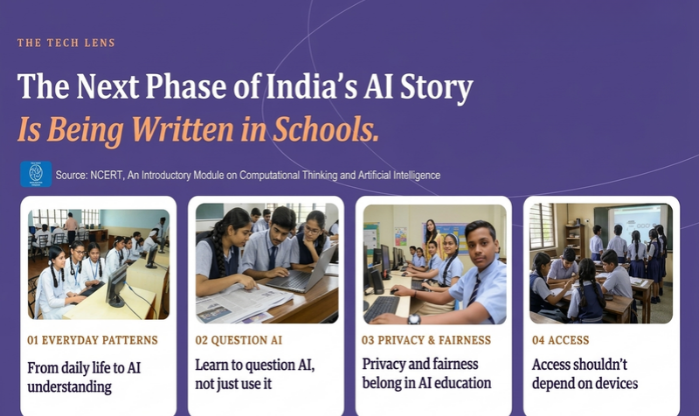
1. From everyday patterns to AI understanding
It starts with things students already know.
Recognising a friend in a crowded canteen, predicting a word on a phone keyboard or spotting patterns in daily routines can introduce computational thinking. Students learn to break problems into manageable parts and develop systematic solutions.
They also explore how AI systems learn from examples and how they differ from devices that follow fixed rules. AI literacy, therefore, isn’t just for future programmers. It helps learners understand recommendation systems, digital assistants and automated decisions that shape everyday life.
The 20-hour module uses discussions, exercises and reflection. Students maintain a “Curious Notebook” to record their observations and questions. The idea is to build a habit of inquiry, not simply memorise terminology.
2. Learning to question AI, not just use it
AI can sound convincing and still be wrong.
One part of the module examines inaccurate outputs, misinformation and manipulated images, including deepfakes. In an activity called “Hallucination Hunt,” students test an AI assistant on a topic they already know and identify errors instead of treating confident language as proof.
The module encourages students to check sources, examine claims, compare information and pause before sharing. These skills matter as AI-generated content spreads across the internet.
And there’s a bigger lesson here. An AI response can be useful without being authoritative. Whether students are checking schoolwork, evaluating news or eventually using AI at work, verification and independent judgement remain essential.
3. Privacy and fairness belong in AI education
Using AI responsibly also means thinking about the people behind the data.
The module introduces data privacy, consent, fairness and digital safety. Students examine what information an app collects, why it needs it, who may receive it, how long it is retained and whether it can be deleted.
Consider a practical question: should school notes containing classmates’ personal details be uploaded to an AI tool? Another activity explores what it means when facial-recognition technology repeatedly fails to recognise someone.
These examples connect abstract ethical principles to decisions young people may encounter online.
Responsible AI use isn’t only about avoiding incorrect answers. It also means protecting other people’s information, questioning biased outcomes and understanding that convenience doesn’t replace consent.
4. Access should not depend on devices
AI education needs to work beyond well-equipped computer labs.
The module includes activities that can be conducted with or without digital devices. Teachers can demonstrate tools on a shared screen, while students explore some concepts through paper-based exercises and discussion.
That flexibility matters because schools differ in connectivity and access to equipment. A curriculum that works only in well-resourced computer labs risks widening existing gaps.
Offline activities can’t replace access to technology, but they can help more classrooms begin building foundational understanding.
Implementation will still depend on teacher preparation, classroom time, language accessibility and opportunities to practise. The real impact will come from how consistently schools bring these ideas to life.
The Tech Lens takeaway: AI readiness starts with judgement
NCERT’s module is a constructive step towards mainstream AI literacy. It connects technology with problem-solving, critical thinking, privacy and ethics, while reinforcing that human creativity and judgement remain central.
The students learning these skills today will join the workforce within a decade, expecting AI to be used critically and responsibly. Many current teams haven’t been taught to verify AI outputs, protect data or question biased results. The same habits are worth building now.
India’s AI future won’t be shaped by access to tools alone. It will depend on learners having the confidence to explore technology, the discipline to question it and the responsibility to use it for human benefit.
The real AI skill isn’t prompting. It’s knowing when not to trust the answer.
Sources and references
NCERT: An Introductory Module on Computational Thinking and Artificial Intelligence
https://www.ncert.nic.in/pdf/An_Introductory_Module_AI_CT_UN514.pdf