 AI News
The enterprise AI debate has concentrated on tools while the harder question has waited underneath: how should work change when people and intelligent systems can share tasks, decisions and accountability? Buying access is easy. Redesigning roles, incentives, management routines and career paths is the real transformation.
McKinsey's July 2026 operating-model research reports that only 21% of companies had fundamentally redesigned their operating models around AI. AI high performers were three times more likely to pursue broad operating-model redesign and twice as likely to redesign workflows before choosing tools. [1] For Indian enterprises, workforce architecture is now a source of competitive advantage.
| Workforce principle: Do not automate a task before deciding what happens to the saved capacity, who remains accountable and what new skill the employee needs to perform the redesigned role. |
Move From Job Replacement to Task Redesign
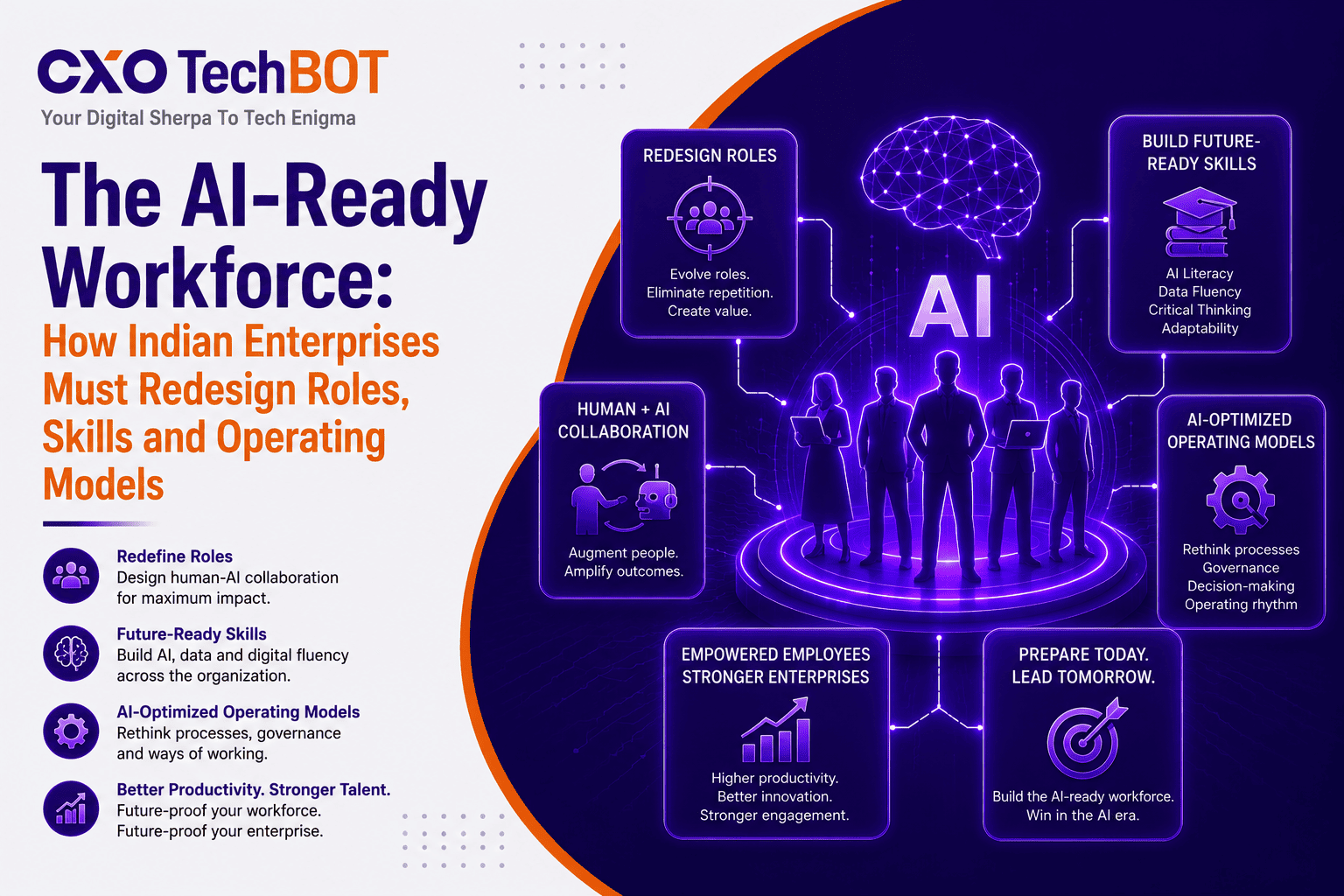
Jobs are bundles of tasks. Some tasks can be automated, some accelerated, some elevated by better information and some should remain human because they require empathy, accountability, negotiation or contextual judgement. Leaders should map work at task level before making workforce assumptions.
The objective is not simply to remove hours. Capacity can be reinvested in growth, quality, resilience, customer intimacy or innovation. Without an explicit choice, saved time often disappears into more meetings and messages rather than measurable value.
The Roles Emerging in an AI-First Operating Model
Domain leaders will own AI-enabled outcomes. AI product owners will manage workflows rather than isolated models. Human–AI workflow architects will decide how tasks move between employees, agents and systems. Data and knowledge stewards will maintain trusted context. Risk specialists will define controls and escalation. Frontline managers will coach teams using AI-generated evidence.
McKinsey notes that organisations are creating hybrid workforces in which humans and agents operate side by side, increasing the importance of domain leaders, AI product owners, workflow architects and knowledge specialists. [2] These are not all new job titles; many are expanded accountabilities within existing roles.
Skills Indian Enterprises Need to Build
AI literacy should be universal but role-specific. Executives need economics, governance and operating-model fluency. Managers need workflow redesign and adoption skills. Specialists need evaluation, data and tool expertise. Employees need critical thinking, verification, secure use and the confidence to challenge AI output.
Industrial contexts require combined expertise. The industrial automation AI trends shaping factories increase demand for people who understand operations, controls, safety and data, not only algorithms. IoT AI integration enterprise India programmes need engineers who can translate sensor signals into operational decisions. Generative AI use cases manufacturing teams need shop-floor knowledge and multilingual change capability. Even quantum computing enterprise applications will depend on leaders who can identify genuine optimisation problems before the technology matures.
A Workforce Redesign Method
Select a business domain, map value streams and identify bottlenecks. Break priority roles into tasks and classify each task as human-led, AI-assisted, agent-executed with review, or unsuitable for AI. Redesign the workflow, decision rights, controls, metrics and role expectations together.
Pilot with employees, not to employees. Involve frontline experts in defining failure modes and practical controls. Provide protected learning time, manager coaching and a clear explanation of how capacity gains will be used. Trust weakens when productivity objectives are hidden or when employees bear the risk of imperfect tools.
Measure Value and Workforce Health Together
Track cycle time, quality, customer outcomes, risk, cost and revenue alongside adoption, employee confidence, skill progression and workload. High usage can coexist with poor value; short-term efficiency can coexist with burnout or control failures.
IBM's 2026 CEO Study finds 69% of CEOs say AI is changing aspects of the business they consider core, while 77% say talent and technology leadership roles are converging. [3] The leadership agenda is therefore integrated: strategy, technology and people can no longer be transformed in separate programmes.
The Leadership Contract for Workforce Transformation
Employees need clarity on three questions: why the workflow is changing, how performance will be assessed and what support exists when the technology is wrong. Leaders should publish principles for responsible workforce transition, including learning commitments, human review rights, data protection and how material role changes will be communicated.
Managers are the critical translation layer. They need practical tools to redesign work, set realistic expectations, recognise good verification behaviour and prevent AI from becoming invisible overtime. If managers are measured only on short-term output, they may encourage unsafe shortcuts or conceal the time required to correct weak results.
The most credible transformation is reciprocal: the enterprise asks employees to learn new ways of working and, in return, invests in skills, mobility and better jobs. When people can see how AI improves customer outcomes and expands their contribution, not merely how it cuts cost-adoption becomes more durable and the organisation captures more of the technology's strategic value.
Frequently Asked Questions
What is an AI-ready workforce?
It is a workforce with the skills, roles, management systems and governance needed for people and AI to collaborate safely and productively across redesigned workflows.
Which AI skills should every employee learn?
Employees need role-appropriate prompting, verification, data-security awareness, critical thinking, escalation and an understanding of when AI should not be used.
How should companies decide which tasks to automate?
Assess repetition, rules, data quality, consequence of error, need for human judgement and reversibility. Start with bounded tasks where outcomes can be measured and reviewed.
How can leaders maintain employee trust during AI transformation?
Be transparent about objectives, involve employees in workflow design, provide learning time, protect escalation, measure workload and explain how productivity gains affect roles and opportunities.
| Sources & References | ||
| [1] | McKinsey — The Operating Model Advantage: Why AI Winners Are Rewiring Their Organizations (July 2026) | https://www.mckinsey.com/industries/industrials/our-insights/the-operating-model-advantage-why-ai-winners-are-rewiring-their-organizations |
| [2] | McKinsey — Rewiring Talent to Value in the Age of AI (June 2026) | https://www.mckinsey.com/capabilities/people-and-organizational-performance/our-insights/rewiring-talent-to-value-in-the-age-of-ai |
| [3] | IBM Institute for Business Value — 2026 CEO Study | https://www.ibm.com/thought-leadership/institute-business-value/en-us/c-suite-study/ceo/ |