 AI News
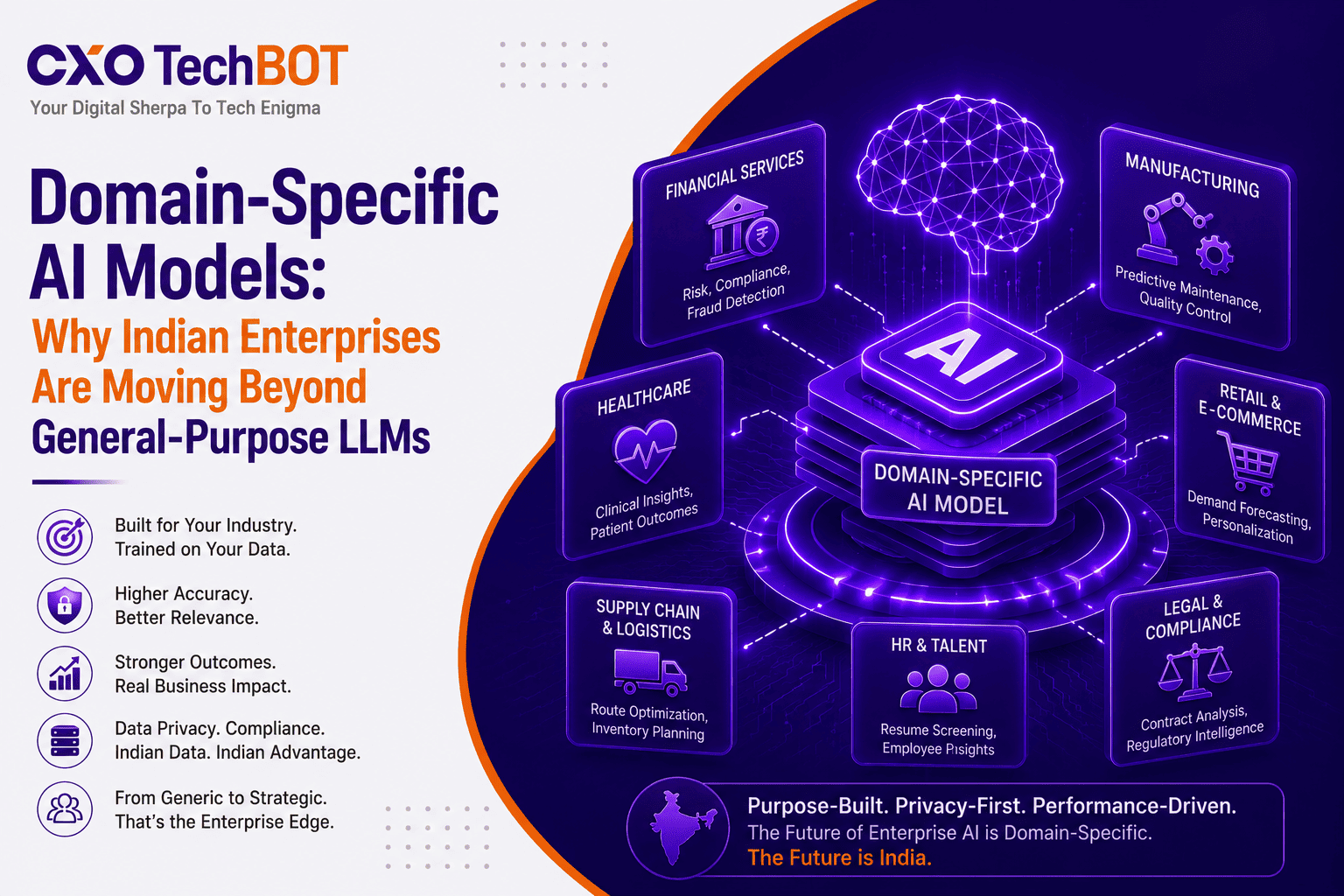
The first phase of enterprise generative AI rewarded breadth: one general-purpose model could summarise, draft and answer questions across many domains. The next phase will reward precision. A model supporting credit, clinical, legal, engineering or compliance work must understand specialised terminology, rules, formats and consequences that generic fluency cannot guarantee.
Gartner predicts organisations will use small, task-specific models at least three times more than general-purpose large language models by 2027. Its 2026 analysis says domain-specific language models can offer up to 50% lower development costs, faster deployment and higher reliability in business-critical workflows. [1][2] The strategic question is no longer which single model will win, but which model mix best serves each enterprise domain.
| Decision rule: Use the smallest, most controllable model that reliably meets the business requirement. Model prestige is not an enterprise outcome; accuracy, compliance, speed and economics are. |
What Is a Domain-Specific Language Model?
A domain-specific language model is created or optimised for an industry, function or class of task. It may be trained from scratch, fine-tuned on specialised data, supported by retrieval-augmented generation or combined with rules and tools. The objective is not maximum general knowledge; it is reliable performance inside a defined context.
For BFSI digital transformation AI, that context might include product terms, regulatory obligations, transaction patterns, credit policies and approved communication language. In manufacturing it could include equipment manuals, maintenance histories and quality specifications. The value lies in understanding the enterprise's operational language.
Why General-Purpose Models Fall Short
Generic models can misunderstand specialised abbreviations, apply outdated assumptions or generate a persuasive answer that violates policy. Larger models also bring higher inference cost and may require sending sensitive context to an external environment. A right-sized specialised model can be faster, cheaper and easier to constrain.
Specialisation is not automatically superior. A narrow model may suffer from limited coverage or catastrophic forgetting outside its task. Enterprises should compare fine-tuning with retrieval, prompt design, rules and conventional analytics. The simplest architecture that meets accuracy, control and cost requirements is usually preferable.
The Data Advantage-and the Data Burden
Domain models turn proprietary knowledge into differentiation, but only if that knowledge is accurate, current, permissioned and representative. Poorly curated policy documents or historical decisions can encode contradictions and bias. Data teams need provenance, versioning, quality controls, access rights and a process for retiring obsolete information.
Evaluation must be built from realistic domain tasks. Subject-matter experts should define expected answers, unacceptable failure modes and escalation rules. Accuracy alone is insufficient; leaders should test factuality, compliance, explainability, consistency, latency, cost and performance across languages relevant to Indian users.
How Specialised Models Strengthen Enterprise Agents
AI agentic systems for enterprise depend on context to choose sensible actions. A specialised model can improve the reasoning layer for agentic AI business applications by grounding decisions in domain terminology, policies and workflows. Yet agents require separate controls for identity, permissions, tools and human approval.
Autonomous AI enterprise adoption should therefore progress by bounded domain. Begin with an advisory role, observe performance, allow low-risk actions with verification, and expand autonomy only where evidence supports it. The model, workflow and governance system should be evaluated together.
The Enterprise Model Portfolio
CIOs should expect a portfolio: a general model for broad productivity, domain models for specialised knowledge, small task models for high-volume execution and traditional machine learning for structured prediction. A routing layer can direct work based on sensitivity, complexity, cost and required capability.
The competitive advantage will not come from possessing the largest model. It will come from combining trusted proprietary context, disciplined evaluation and workflow integration more effectively than competitors.
How to Launch a Domain-Model Programme
Begin with a workflow where generic models have a documented quality, latency or cost problem. Assemble a small cross-functional team: domain expert, product owner, data specialist, model engineer, risk representative and process owner. Define a benchmark using real tasks, including difficult edge cases and examples where the correct answer is to refuse or escalate.
Compare at least three approaches: a capable general model with retrieval, a smaller specialised model and a composite workflow that combines models with rules or traditional analytics. Measure end-to-end performance rather than isolated model accuracy. Include data preparation, human review, infrastructure, monitoring and maintenance in the total cost.
Treat the domain model as a living product. Policies, products and language change, so data and evaluations require owners and release cycles. Monitor drift, user feedback and failures in production. A specialised model that is not maintained will gradually lose the contextual advantage that justified its creation.
Frequently Asked Questions
How is a domain-specific model different from a general LLM?
A domain-specific model is optimised for a defined industry, function or task using specialised data and evaluation. A general LLM aims to perform reasonably across a much wider range of subjects.
Is fine-tuning always required?
No. Retrieval-augmented generation, strong prompting, rules or a smaller task model may meet the requirement. Enterprises should compare approaches using realistic evaluations.
Which sectors benefit most from specialised AI models?
Regulated and knowledge-intensive sectors, including banking, insurance, healthcare, pharmaceuticals, legal services and manufacturing, often benefit because terminology, policy and accuracy requirements are highly specific.
Can domain-specific models reduce AI costs?
Yes. Smaller or right-sized models can use less compute and provide faster responses, although data preparation, evaluation, integration and governance costs must be included in the business case.
| Sources & References | ||
| [1] | Gartner — Domain-Specific Language Models as Enterprise AI Precision Tools (March 2026) | https://www.gartner.com/en/articles/domain-specific-language-models |
| [2] | Gartner — Small Task-Specific Models to Outpace General-Purpose LLMs | https://www.gartner.com/en/newsroom/press-releases/2025-04-09-gartner-predicts-by-2027-organizations-will-use-small-task-specific-ai-models-three-times-more-than-general-purpose-large-language-models |
| [3] | IBM — What Is a Domain-Specific LLM? | https://www.ibm.com/think/topics/domain-specific-llm |
\f