 AI News
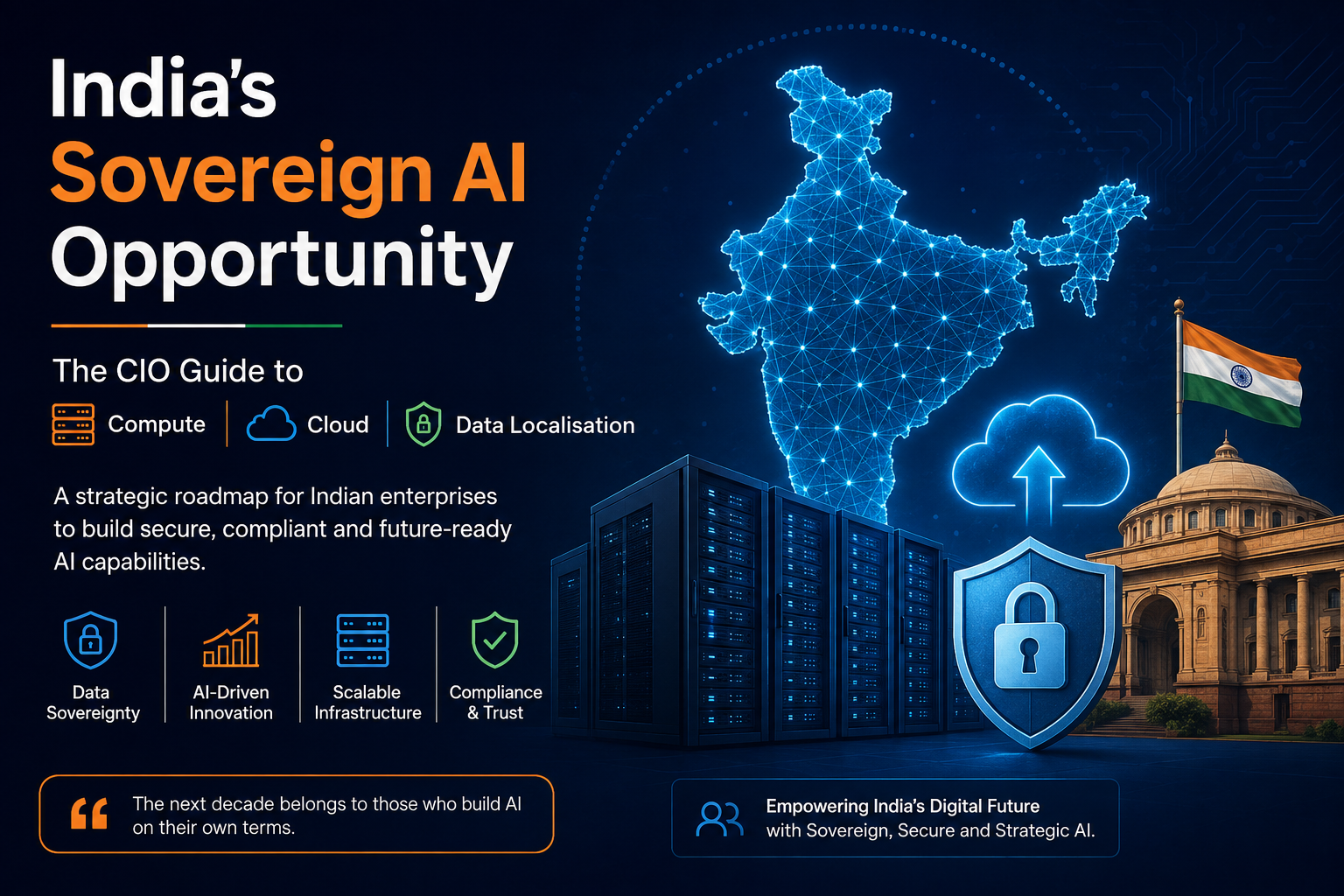
India's AI ambition is becoming a physical-infrastructure question. Models may feel weightless, but enterprise AI depends on data centres, accelerators, power, cooling, fibre, cloud contracts and legally defensible data flows. For CIOs, sovereign AI is therefore not a slogan about building everything locally. It is a disciplined approach to controlling where critical AI capabilities run, which laws apply and how easily the enterprise can change providers.
Deloitte projects India's installed data-centre capacity could rise from roughly 1.5 GW in 2025 to about 10 GW by 2030. It also estimates the semiconductor market could reach approximately US$120 billion by 2030. [1] The scale of this build-out will create new choices—and new dependencies—for Indian enterprises.
| Strategic insight: Sovereignty is not the same as self-sufficiency. The enterprise objective is controlled dependency—knowing where reliance exists, limiting concentration risk and retaining credible options when technology, regulation or geopolitics changes. |
What Sovereign AI Means for an Enterprise
Sovereign AI is the ability to develop, operate and govern AI under defined national, sectoral and organisational requirements. It includes data residency, control over model and infrastructure choices, access to compute, local-language and cultural context, security, auditability and continuity of service.
An enterprise does not need to own a data centre or train a frontier model to strengthen sovereignty. It does need to understand its dependency chain: where prompts and data are processed, where logs are stored, which subcontractors are involved, how models are updated and whether workloads can move without expensive redesign.
The Infrastructure Reality Behind India's AI Growth
Deloitte estimates that India's data-centre expansion could require an additional 40–45 TWh of power, while earlier analysis indicated a need for 45–50 million additional square feet of real estate by 2030. [1][2] Power availability, grid reliability, water use and cooling will increasingly shape location and cost.
GPU access is another strategic constraint. Training is compute-intensive, but inference at enterprise scale can also create persistent demand. CIOs should distinguish burst workloads from steady workloads, latency-sensitive applications from batch processing and sensitive data from commodity use. One default cloud choice will rarely optimise all four.
A Workload-by-Workload Cloud AI Strategy for Enterprises
Classify workloads across five dimensions: data sensitivity, latency, regulatory exposure, scale variability and strategic differentiation. Public cloud may be ideal for variable experimentation; sovereign or regional cloud may suit regulated data; private infrastructure may be justified for stable, high-utilisation or highly sensitive workloads; edge deployment may be required for low latency or operational continuity.
The architecture should preserve portability at the data, model and orchestration layers. Use open interfaces where practical, maintain exportable logs and embeddings, separate proprietary business logic from vendor-specific services and test recovery to an alternative environment. Portability that has never been exercised is only an assumption.
Confidential computing can add protection for data in use by isolating workloads in hardware-backed trusted environments. It will not solve weak identity, bad data governance or insecure applications, but it can become an important control for cross-organisation analytics and regulated AI.
The CIO Decision Framework
First, identify which AI capabilities are genuinely strategic and which are utilities. Second, model total cost across compute, storage, networking, engineering, observability and exit. Third, assess jurisdiction, subcontractors, support, model availability and operational resilience. Fourth, negotiate portability, audit and incident clauses before scale creates lock-in.
Firms seeking enterprise AI advisory India support should insist on architecture-neutral economics, not a recommendation shaped by resale incentives. Likewise, digital transformation advisory India programmes should connect infrastructure choices to business outcomes, regulatory exposure and future bargaining power.
As a CXO technology magazine India’s leaders use for enterprise intelligence, CXOTechBot sees sovereign AI as a portfolio discipline: place each workload where it achieves the right balance of control, performance, compliance and cost.
What a Resilient Sovereign AI Portfolio Looks Like
By year-end, CIOs should be able to explain the placement logic for every material AI workload. The organisation should know which data must remain in India or within a regulated boundary, which workloads can use global public services, where low-latency edge processing is necessary and which strategic capabilities deserve additional control.
Financial transparency is equally important. Infrastructure decisions should be based on utilisation, performance, engineering effort and risk-adjusted exit costs, not headline compute prices. Chargeback or showback can reveal which applications consume value and which merely consume capacity. Sustainability metrics should include power efficiency, cooling and carbon implications where these are material.
A resilient portfolio is deliberately heterogeneous but operationally coherent. Common identity, data governance, observability and policy standards span environments, while workload placement remains flexible. This lets the enterprise benefit from rapid innovation without surrendering control over its most sensitive information or strategically important processes.
Frequently Asked Questions
What is sovereign AI?
Sovereign AI is the capability to build, operate and govern AI under defined local laws, infrastructure controls, data requirements and cultural context while retaining strategic control over critical dependencies.
Does sovereign AI require on-premises infrastructure?
No. Enterprises can combine public, sovereign and private cloud with edge infrastructure. The appropriate choice depends on data sensitivity, regulation, latency, utilisation, resilience and cost.
How can CIOs reduce AI vendor lock-in?
Separate data and orchestration from proprietary services, use open interfaces where practical, retain export rights, document dependencies and periodically test moving a representative workload.
Why is power availability relevant to AI strategy?
AI data centres require dense, reliable electricity and cooling. Power constraints affect capacity, location, sustainability, price and the ability to scale compute-intensive workloads.
| Sources & References | ||
| [1] | Deloitte India — TMT Predictions 2026: India Scales Compute and Semiconductors | https://www.deloitte.com/in/en/about/press-room/beyond-ai-hype-india-scales-compute-and-semiconductors-tmt-predictions-2026-pr.html |
| [2] | Deloitte India — India's AI Surge and Data-Centre Infrastructure Requirements | https://www.deloitte.com/in/en/about/press-room/indias-ai-surge-could-require-an-additional-45-50-million-sq-ft-real-estate.html |
| [3] | Gartner — Top Strategic Technology Trends for 2026 | https://www.gartner.com/en/newsroom/press-releases/2025-10-20-gartner-identifies-the-top-strategic-technology-trends-for-2026 |
\f