 AI News
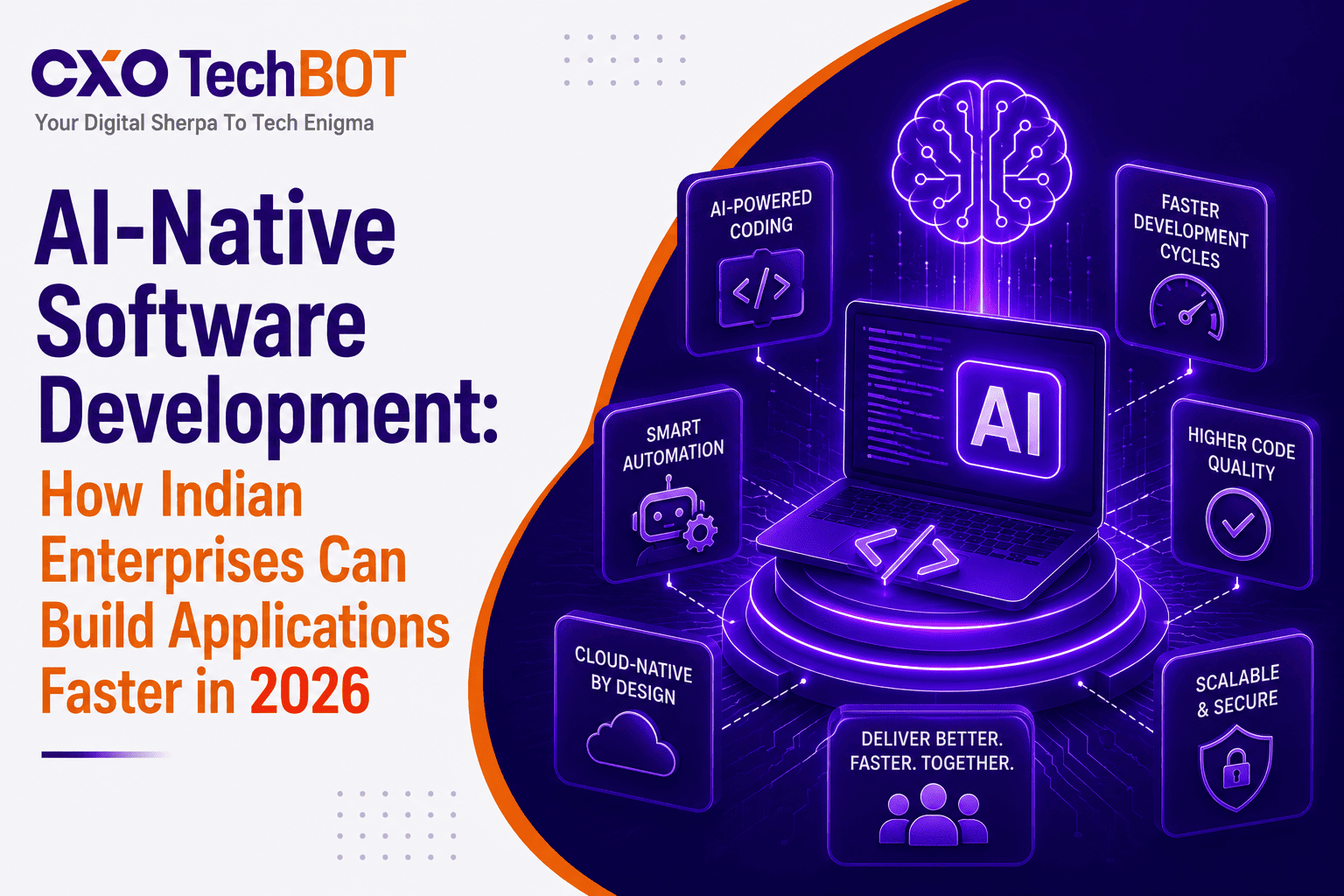
Software development is moving from AI-assisted coding to AI-native delivery. The distinction matters. A developer using a copilot may write an individual function faster; an AI-native engineering system can help translate requirements, generate code, create tests, review changes, update documentation and coordinate work across the software lifecycle.
Gartner reported in May 2026 that enterprise AI coding agents are entering a new phase of expansion and predicts that by 2027 more than 65% of engineering teams using agentic coding will treat the traditional integrated development environment as optional, shifting more governance and validation to automated platforms. [1] Indian CIOs should prepare for a redesign of engineering, not simply a new productivity licence.
| Leadership principle: AI-generated code is not the product. A reliable customer or employee outcome is the product. Measure the complete delivery system, including quality, security, adoption and maintainability. |
What Makes Development AI-Native?
AI-native development begins with outcomes and constraints rather than a detailed sequence of manual coding tasks. Human teams define the product intent, architecture, policies and acceptance criteria. AI systems decompose work, propose implementations and run iterative validation. Engineers concentrate on judgement, system design, security, integration and exception handling.
This does not remove engineering discipline. It increases the importance of specifications, automated tests, observability and architecture because AI can generate weak code as rapidly as strong code. The bottleneck moves from typing to deciding what should be built and proving that it works safely.
Where the Enterprise Value Comes From
The obvious gain is speed, but the larger opportunity is to reduce coordination friction across requirements, development, testing, operations and documentation. AI can help modernise legacy code, generate test coverage, explain unfamiliar systems and make internal platforms easier to use.
Google Cloud's DORA research frames successful AI adoption as a systems problem rather than a tools problem. Local productivity improvements do not automatically improve product performance; strong platforms, value-stream management, user focus and organisational capabilities determine whether speed becomes value or downstream instability. [2]
The Risks CIOs Must Control
First is code quality. Plausible output can contain security vulnerabilities, incorrect dependencies or architecture drift. Second is provenance: enterprises need to know what generated code, which models and components were used and whether licensing obligations apply. Third is confidentiality, especially when proprietary code enters external services. Fourth is skill atrophy if teams accept output without understanding systems.
Controls should include approved tools and models, protected repositories, automated security scanning, test thresholds, dependency policies, signed artifacts, human review for high-risk changes and complete traceability from requirement to deployment. Metrics must include escaped defects, rework, lead time, reliability and customer outcomes—not lines of code generated.
How to Implement AI in Business India: The Engineering Playbook
Select one product area with good automated tests, clear ownership and meaningful delivery demand. Establish a baseline for lead time, defects, deployment frequency and developer experience. Introduce AI across a bounded part of the lifecycle, train teams in specification and review, and compare system-level outcomes over several releases.
Create a small AI engineering platform team to standardise approved models, integrations, security and evaluation. Pair it with domain product teams that remain accountable for outcomes. Scale patterns that improve delivery without weakening reliability; retire experiments that only increase activity.
For generative AI for CXOs, the board question is not how many developers have access. It is whether technology throughput, quality and innovation economics are improving. Peer forums such as a CXO leaders council technology community—and practitioner discussions emerging from AI summit India 2026—can help leaders compare operating-model evidence rather than vendor demonstrations.
What Successful AI-Native Engineering Looks Like
Success is visible in the flow of value, not the volume of generated code. Product teams release useful changes faster, defects do not rise, recovery becomes easier and developers spend more time on architecture, customer understanding and complex problem-solving. Documentation and tests improve because they are treated as executable context for both people and AI systems.
Leadership should also watch concentration risk. If an engineering organisation becomes dependent on one model, proprietary workflow or opaque coding platform, short-term speed can create long-term bargaining and continuity problems. Maintain model choice, exportable development records, standard repositories and the capability to continue critical delivery when a provider changes terms or performance.
The winning operating model pairs a small platform team with empowered product teams. The platform team supplies secure tools, reusable patterns, evaluations and observability. Product teams bring domain knowledge and own business outcomes. Together they convert AI from an individual developer convenience into an enterprise software-delivery capability.
Frequently Asked Questions
What is AI-native software development?
It is a software-delivery approach in which AI participates across requirements, design, coding, testing, review, documentation and operations, while humans retain responsibility for intent, architecture, risk and outcomes.
Will AI coding agents replace enterprise developers?
They will automate portions of development and change role boundaries, but enterprises still need engineering judgement, architecture, security, domain knowledge, validation and accountability.
What should CIOs measure in an AI coding pilot?
Track lead time, deployment frequency, test coverage, escaped defects, rework, security findings, reliability, developer experience and customer outcomes against a pre-pilot baseline.
Which applications are best for an initial pilot?
Choose a bounded product with clear ownership, good automated tests, accessible documentation and enough delivery volume to measure change. Avoid the most critical or least understood system first.
| Sources & References | ||
| [1] | Gartner — Enterprise AI Coding Agents Enter a New Phase (May 2026) | https://www.gartner.com/en/newsroom/press-releases/2026-05-20-gartner-says-the-market-for-enterprise-ai-coding-agents-is-entering-a-new-phase-of-expansion-and-competitive-realignment |
| [2] | Google Cloud DORA — State of AI-Assisted Software Development | https://cloud.google.com/resources/content/2025-dora-ai-assisted-software-development-report |
| [3] | Gartner — Top Strategic Technology Trends for 2026 | https://www.gartner.com/en/newsroom/press-releases/2025-10-20-gartner-identifies-the-top-strategic-technology-trends-for-2026 |