 The TechLens
Satellites can capture images of a wildfire, a flooded district or a changing coastline in seconds. Getting that information to the people who need it is another story. The gap between observation and usable insight can stretch from four to 12 hours, according to OXG Space.
The Bengaluru startup has raised ₹17 crore in a funding round led by Aum Ventures, with participation from Skyroot Aerospace co-founders Pawan Kumar Chandana and Bharath Daka, and Cosmoserve founder Chiran Phanindra. Announced on October 14, 2026, the funding will support its next technology milestone.
The problem is the wait
Earth-observation satellites collect valuable data for agriculture, disaster response, infrastructure monitoring and defence. But satellites cannot always transmit their observations immediately. They often depend on passing within range of a ground station before sending data back to Earth.
That delay matters. An image showing a flood spreading across a district is more useful when emergency teams can act on it quickly. The same applies to detecting crop stress or monitoring critical infrastructure.
More ground stations can help, but OXG Space believes part of the solution is to move the network closer to the data.
Think edge computing, 500 km above Earth
The idea is simple: stop sending every raw image home before doing any analysis. Let satellites communicate with one another, process selected information in orbit, and transmit the results that matter.
Think edge computing, but in space.
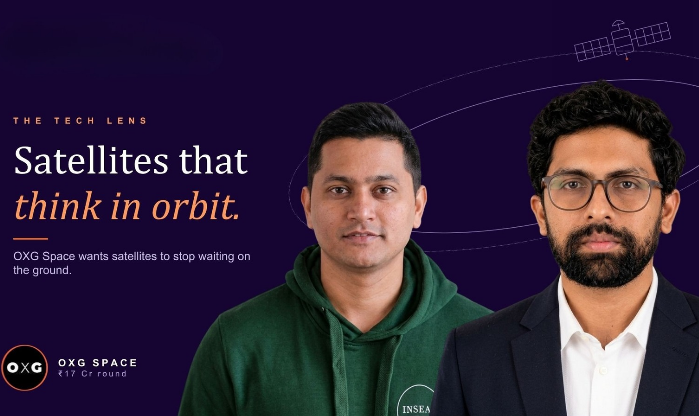
Founded by former ISRO engineers Akash Shetty and Sanjay Gorur, OXG Space is developing an orbital network that combines satellite connectivity with onboard computing. Instead of treating each spacecraft as an isolated system, the company wants to connect satellites and help them turn observations into useful intelligence faster.
The fresh capital will fund Mission Synapse, a 12-month programme to demonstrate the company’s core technologies in orbit. These include a Ka-band phased-array antenna targeting an initial link capacity of 1 Gbps, a deployable mesh reflector for communication links, and a solar array to power the system.
Where this lands
Three potential applications stand out:
Disaster response: Emergency teams could receive flood or wildfire intelligence sooner, helping them prioritise response efforts.
Agriculture and insurance: Agritech companies could track crop stress, while insurers could assess flood damage and identify affected areas faster.
Defence and intelligence: Connecting data from different satellite sensors could help analysts build a more timely picture of changing conditions.
These are potential applications, not demonstrated customer outcomes. The value will depend on how reliably the network works and how quickly useful information reaches users.
The catch? It hasn’t been proven in orbit yet. Mission Synapse will test whether OXG Space can make its proposed connectivity and computing infrastructure work under real space conditions. High-speed links and reliable onboard processing are engineering challenges, not just software problems.
The Tech Lens takeaway
The next leap in satellite technology may not come from collecting more images. It may come from making sense of the ones we already have, while they still matter.