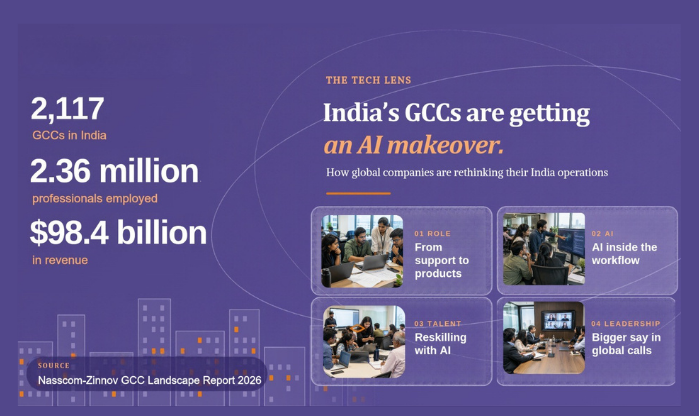
 The TechLens
For years, global companies looked at India as a destination to build large technology teams, manage business operations and keep costs under control. Today, that relationship is changing. India is no longer just a place where global businesses get work done. It is increasingly becoming a place where they build products, develop artificial intelligence (AI), solve complex business problems and shape decisions that influence their worldwide operations.
At the centre of this transformation are Global Capability Centres (GCCs). Once known primarily as offshore support centres, these operations are taking on a much bigger role as companies rethink how they work in an AI-driven economy.
According to the Nasscom-Zinnov GCC Landscape Report 2026, India has 2,117 GCCs employing approximately 2.36 million professionals and generating $98.4 billion in revenue. The ecosystem has grown 32% since FY2021, reflecting how important India has become to global business operations.
But the bigger story is not just about the number of centres or people they employ. It is about what these centres are now being trusted to do.
From handling operations to building global products
Traditionally, many GCCs focused on functions such as IT support, finance, customer service, software maintenance and business process management. Their success was often measured by efficiency, operational scale and cost savings.
That approach is gradually giving way to something more ambitious.
Global companies are increasingly assigning their Indian centres responsibilities involving product engineering, AI research, cybersecurity, data science, cloud infrastructure and digital transformation. Instead of simply executing instructions from headquarters, teams in India are beginning to own products, platforms and business-critical technology initiatives.
The change is also visible in how new GCCs are being established. The Nasscom-Zinnov report indicates that nearly half of the GCCs set up since FY2021 were designed with AI as a core focus from the beginning.
This means AI is no longer being treated as an additional technology project. For many companies, it is becoming part of the centre’s purpose from day one.
AI is changing what happens inside GCCs
The growing adoption of generative AI and agentic AI is giving this transformation another push.
Think about the everyday work happening inside a large global enterprise. Teams spend considerable time reviewing documents, writing code, testing software, analysing data, preparing reports and managing repetitive workflows. AI tools can now assist with many of these activities, while AI agents are beginning to handle more complex, multi-step tasks with varying levels of human supervision.
For GCCs, this creates an opportunity to redesign entire workflows rather than simply make existing processes faster.
An engineering team, for instance, can use AI to accelerate software development and testing. Finance teams can automate parts of reporting and reconciliation, while cybersecurity teams can use AI to analyse threats and support faster responses.
EY’s 2025 GCC Pulse Survey found that 83% of Indian GCCs were investing in generative AI, while 58% were already investing in agentic AI. Another 29% planned to invest in agentic AI within the following year.
The direction is becoming clear: companies want their Indian centres to do more than adopt AI tools. They want these centres to help build, deploy and govern AI across the enterprise.
The talent equation is changing too
As the nature of work changes, the skills companies need are changing with it.
Traditional technology expertise remains important, but organisations are increasingly looking for professionals who understand AI, machine learning, cloud platforms, data engineering, cybersecurity and automation. Just as importantly, they need people who can connect technology with actual business requirements.
This is also changing the way GCCs approach their existing workforce. Rather than depending entirely on external hiring, companies are investing in reskilling employees and helping teams become comfortable working alongside AI systems.
The transition will not be equally easy for everyone. Roles built around repetitive tasks may change significantly, while demand for specialised technology skills and people capable of managing AI-driven systems is expected to grow.
A September 2026 report by Business Standard highlighted how Indian GCCs are increasingly focusing on AI upskilling, automation and digital product thinking to prepare their workforce for this shift.
For employees, the message is straightforward: understanding how to work with AI is becoming as important as knowing how to work with technology itself.
India is becoming a bigger part of global decision-making
Perhaps the most interesting development is the growing influence of Indian GCC leaders within their global organisations.
As centres take ownership of products, technology platforms and enterprise-wide functions, their leadership teams are gaining greater responsibility. Decisions that were once concentrated at overseas headquarters are increasingly involving leaders based in India.
The Nasscom-Zinnov 2026 report highlights this shift, noting that 64% of GCC site leaders now hold dual mandates combining local centre leadership with global functional responsibilities.
This is an important change. It signals that India’s role is moving beyond delivering services towards influencing how global businesses operate, innovate and compete.
However, this opportunity also brings new expectations. Companies will need stronger leadership pipelines, better AI governance, effective data protection and the ability to attract and retain specialised talent.
What comes next for India’s GCC ecosystem?
The next phase of GCC growth will not simply be about opening more offices or hiring larger teams. It will be about building centres that can create intellectual property, develop AI-powered products, manage critical technology platforms and contribute directly to business strategy.
For global companies, India offers a combination of technology talent, an established digital ecosystem and the ability to build capabilities at scale. For India, the opportunity is even bigger: to move further up the global technology value chain.
The question is no longer whether GCCs in India can support global businesses. They already do that at scale. The real question is how much of the future of these businesses will be built, managed and led from India.
And with AI changing the way organisations work, that future may be closer than many companies think.